

The Lost Slide Problem
What the published evidence actually supports about finding, re-using and rebuilding presentation assets, and what it does not.
Free PDF, 14 pages, 21 references
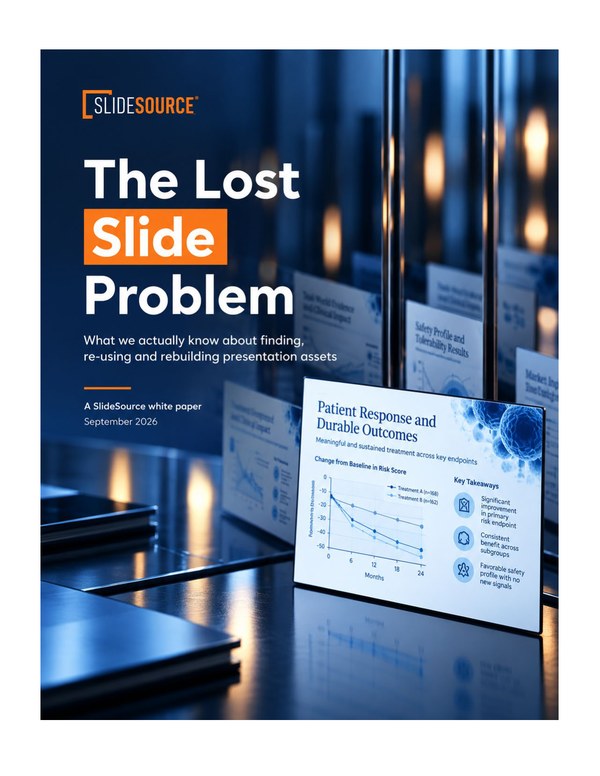
Slides get re-used constantly. But when they move from deck to deck, version, approval, evidence and usage can become disconnected. We reviewed the published research and audited 36 statistics commonly used to quantify this problem, tracing each one back to its source. What we found was surprising: the behavior is real and well described, but the rate and cost of rebuilding slides have never been credibly measured. Not once, in twenty-five years of the industry putting dollar values on it.
What we found
Five findings the published evidence does support
See the evidence behind these findings
Download the full white paper, including the complete audit of 36 circulating statistics and 21 references.
Finding the slide is only half the problem
Suppose retrieval were solved and the right slide came up first time. It still does not tell the person who found it whether this is the current version, whether it was approved and by whom, whether its figures rest on a source that is still valid, or whether it was built for this audience.
Without those answers the find is a dead end, and one rational move is to build the slide again, this time because it could not be trusted rather than because it was lost.
Finding content is a retrieval problem. Knowing whether you can re-use it is a provenance problem.
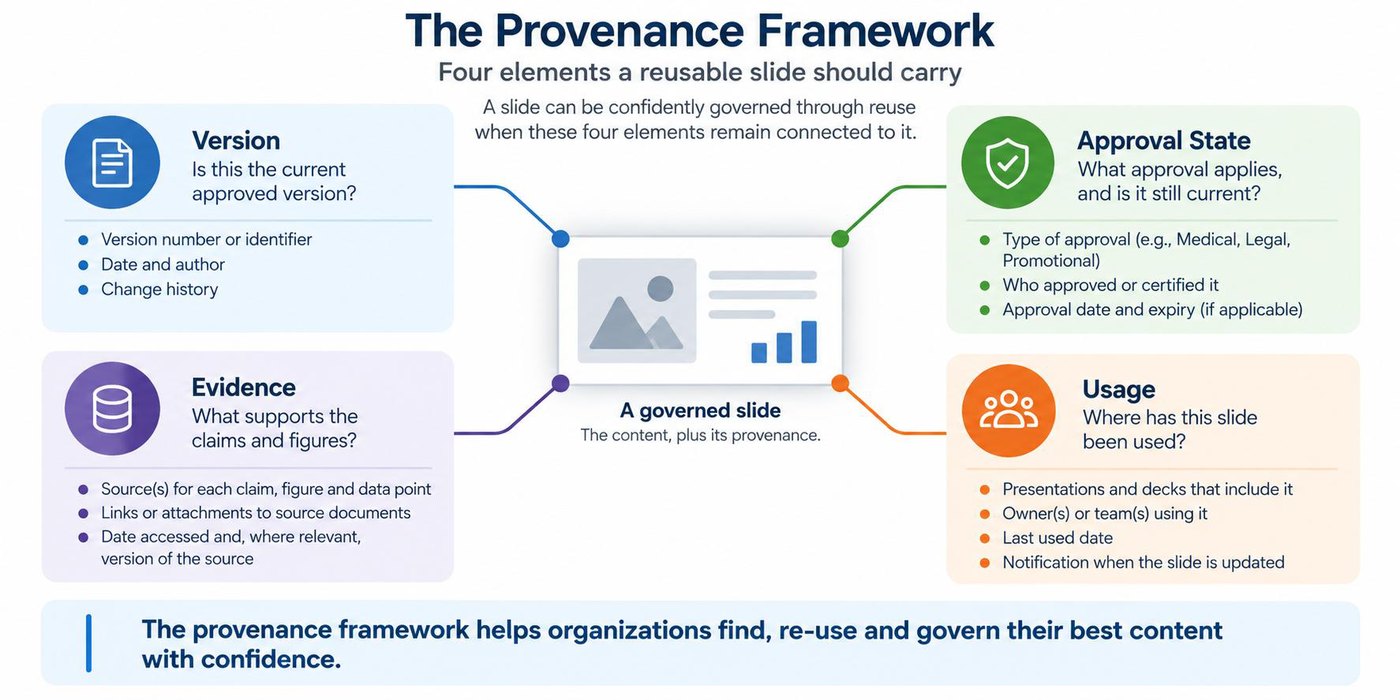
For a slide, provenance means four things:
- Version. Which iteration this is, and whether a newer approved one exists.
- Approval State. What approval applies, who gave it, and whether it still holds.
- Evidence. The source behind each claim and figure, so a change to the source can be traced to every slide that depends on it.
- Usage. Where the slide has been used, so affected presentations can be identified when it changes.
Each one answers a question that otherwise stops a re-use decision dead. Without Version, the safest assumption is that something newer exists somewhere else. Without Approval State, a slide approved eighteen months ago is indistinguishable from one that was never approved at all. Without Evidence, a figure cannot be defended the moment somebody asks where the number came from. Without Usage, nobody can say who else is presenting the slide on the day it turns out to be wrong.
None of those is a storage problem. A perfectly organized drive with faultless naming conventions answers none of them, which is why better filing does not fix this and the research says so.
A slide carrying all four gives a re-user what they need to make a confident decision. A slide carrying none of them is a picture. The framework is deliberately product-independent: any system, process or convention that keeps those four facts attached to the slide is doing the work, and any that lets them fall away is not.
Why this matters now
In governed environments, losing that provenance becomes more than an efficiency problem. In a 2025 FDA action involving a speaker deck, the agency identified its concerns by specific slide number and chart title, and rejected remediation by reference: safety statements elsewhere in the deck and a link to the full Prescribing Information did not mitigate the issue it found.
A slide rebuilt or edited locally may no longer inherit the approval history of the original. The full paper examines that case in detail, along with formal certification requirements in the UK.
The problem also changes as AI becomes part of presentation creation. Historically there was friction in rebuilding, because somebody had to redraw the chart or reassemble the deck. That friction is disappearing. AI can make it easier to find approved content, detect near-duplicates and connect slides to evidence. It can also make creating another version easier than finding the governed one.
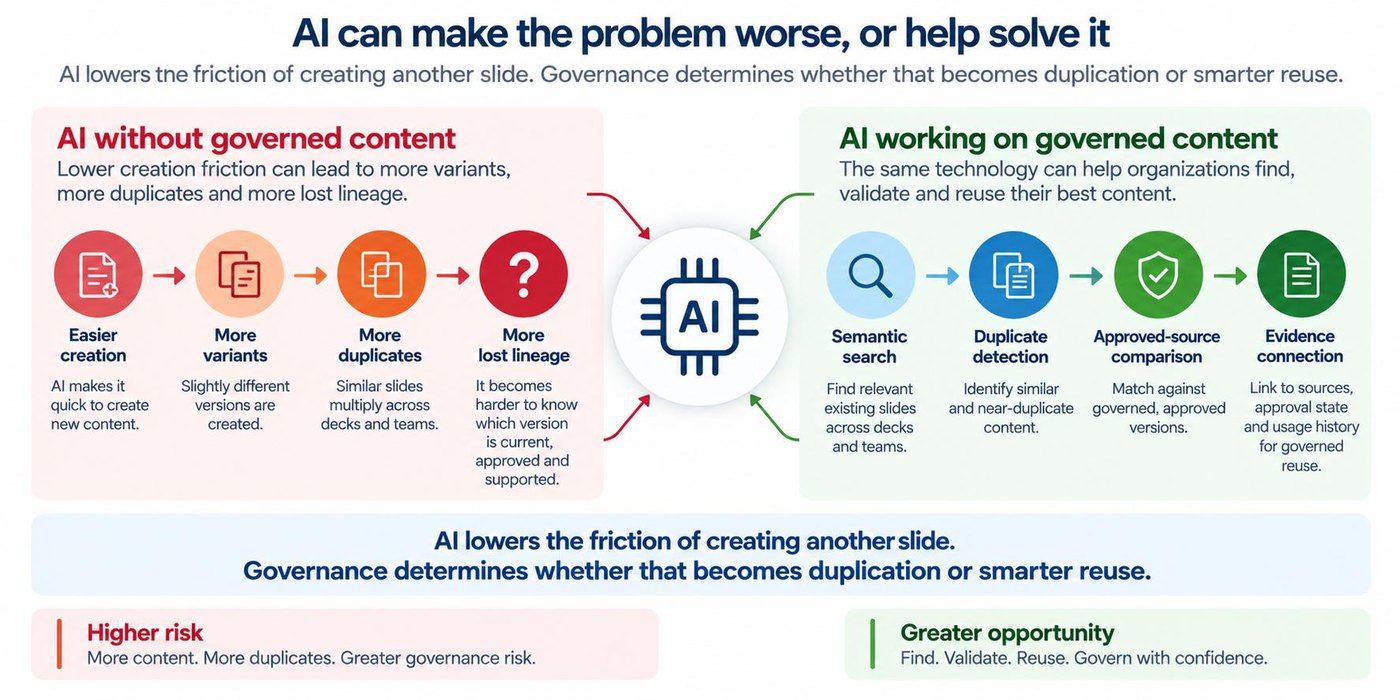
AI may make the Lost Slide Problem worse. It may also become part of the solution. The difference is whether it operates on top of governed content or outside it.
Inside the full white paper
- The complete audit of 36 frequently cited statistics
- The original sources behind the claims, and where they break down
- Research on slide re-use, fragmentation and re-finding
- Regulatory examples where governance applies at the slide level
- The implications of generative AI for re-use and provenance
- Complete source notes and 21 references
The full white paper
The Lost Slide Problem
The Lost Slide Problem is usually treated as a productivity problem. The evidence points at something more fundamental: governance has to travel with the content. Version. Approval State. Evidence. Usage. The download starts right away, and we will email you a copy so you can pass it on.
Common questions
How often do organizations rebuild slides they already own?
Nobody knows. We searched for a credible published measurement and could not find one. No study we located separates rebuilding because a slide could not be found from rebuilding because it could not be trusted. The behavior is well described in the research. The rate is unknown.
What is slide provenance?
Four facts that let someone decide whether a slide they have found can actually be used. Version, which iteration this is and whether a newer approved one exists. Approval State, what approval applies and whether it still holds. Evidence, the source behind each claim and figure. Usage, where the slide has already been used. A slide carrying all four supports a confident re-use decision. A slide carrying none of them is a picture.
Does better search solve the Lost Slide Problem?
Not on its own. In a study of 345 long-term email users, people who filed heavily into folders re-found their material at the same success rate as people who barely filed, and took slightly longer doing it. Search and folder discipline both have value. Neither tells you whether the thing you found is current, approved or supported by the right evidence.
How does generative AI affect slide governance?
It cuts both ways. AI lowers the friction of building a new slide, which can mean more near-duplicates and more lost lineage between new content and previously reviewed content. The same capabilities can find a slide by meaning rather than filename, detect near-duplicates, compare a working slide against its approved source and surface the approved asset before someone creates another version. Which effect wins depends on whether AI operates on top of governed content or outside it.
Govern the slide, not just the file.
See how SlideSource Library keeps version, approval, evidence and usage connected to a slide wherever it is re-used.
Explore SlideSource Library