

The Strategic Role of Graphics and Presentations in Medical Affairs
Why clear, scientifically accurate visuals are strategic assets rather than cosmetic ones.
Free PDF, 5 pages
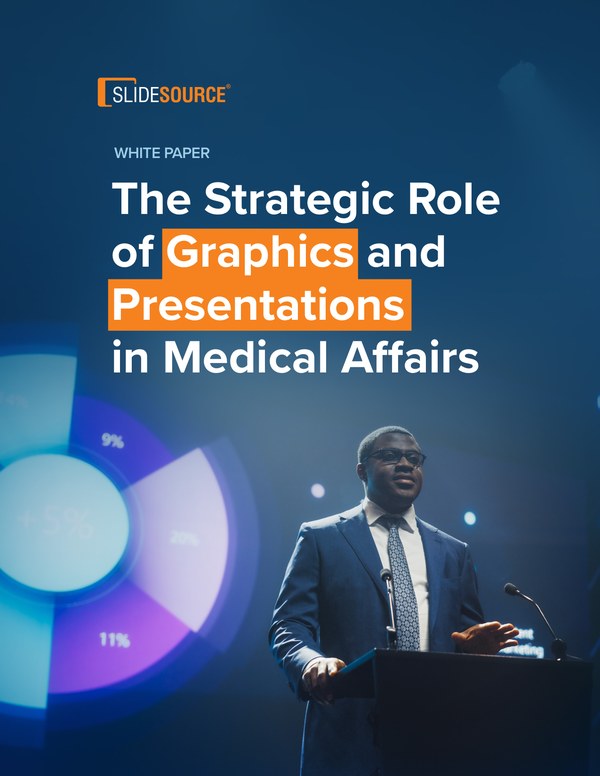
In Medical Affairs, visual quality is not simply a matter of polish. Clear, scientifically accurate graphics can speed understanding, strengthen scientific exchange, reinforce credibility, and help reduce compliance risk.
Medical Affairs sits at the intersection of cutting-edge science, clinical practice, regulatory requirements, and organizational strategy. Data remains the cornerstone of credibility, but how that data is presented is critical to how effectively it reaches each audience.
At a glance
What well-built visuals do for a Medical Affairs team
Prefer the full paper?
Five pages, setting out all six roles graphics play across Medical Affairs.
Why visual communication matters in Medical Affairs
Complex science has to become usable. Medical Affairs regularly translates mechanisms of action, trial results, real-world evidence and other technical material for audiences with very different needs, from specialists who want the detail to executives who need the conclusion. Well-designed visuals simplify without distorting, preserving the nuance and accuracy that make the claim defensible.
Visuals shape scientific exchange. Presentations are not simply containers for information. In advisory boards, MSL interactions, congress symposia and internal discussions, visuals help structure how evidence is explored and discussed. An effective deck is not just a repository of slides; it is a framework for conversation.
Clarity carries strategic value. Clear, scientifically accurate graphics support comprehension, credibility and alignment. Poorly designed material does the reverse, undermining the authority of both the presenter and the organization regardless of how good the underlying work is.
The full white paper examines six specific ways this plays out across Medical Affairs.
Effective visuals are not simply cosmetic. In Medical Affairs, they are part of how complex evidence becomes understandable, credible, and useful.
There is measurable evidence that visual design can affect understanding
In a SlideSource pilot study of 415 participants, the group shown progressively revealed visual information achieved a 24% higher rate of correct answers across four knowledge questions than the control group.
Inside the full white paper
The five-page white paper explores six ways effective graphics and presentations support Medical Affairs:
- Translating complex science into clarity
- Enabling effective peer-to-peer engagement
- Accelerating alignment across functions
- Strengthening scientific credibility
- Maximizing impact at medical congresses
- Supporting compliance, accuracy, and clarity
It also examines why visual communication should be treated as a strategic capability rather than a finishing step.
The full white paper
The Strategic Role of Graphics and Presentations in Medical Affairs
The five-page white paper sets out all six roles in full, with the reasoning behind each, and examines why visual communication belongs in scientific strategy rather than at the end of it. The download starts right away, and we will email you a copy so you can pass it on.
Common questions
Why do graphics matter in Medical Affairs?
Because Medical Affairs communicates dense technical content to audiences who each need something different from it: clinicians, payers, regulators and internal decision-makers. Visuals influence how quickly that content is understood and how the presenter is perceived. They are part of how the science reaches people, not decoration on top of it.
What makes a scientific visual effective rather than decorative?
An effective scientific visual simplifies without distorting, preserving the nuance and accuracy essential to credible medical communication. A decorative one adds visual interest without adding understanding, and in a regulated setting it can obscure the limitations a claim depends on.
How can presentation design support scientific communication?
By making evidence easier to follow and discuss. Clear visuals help structure a conversation around the data, support consistency with corporate and regulatory standards, and let the same scientific content be adapted for a specialist audience or a concise executive summary without becoming two different claims.
Need help turning complex science into a clearer presentation?
SlideSource works with Medical Affairs teams on advisory boards, congress presentations, field medical communications, study results, and other high-value scientific presentations.
Explore Medical Affairs Presentation Design